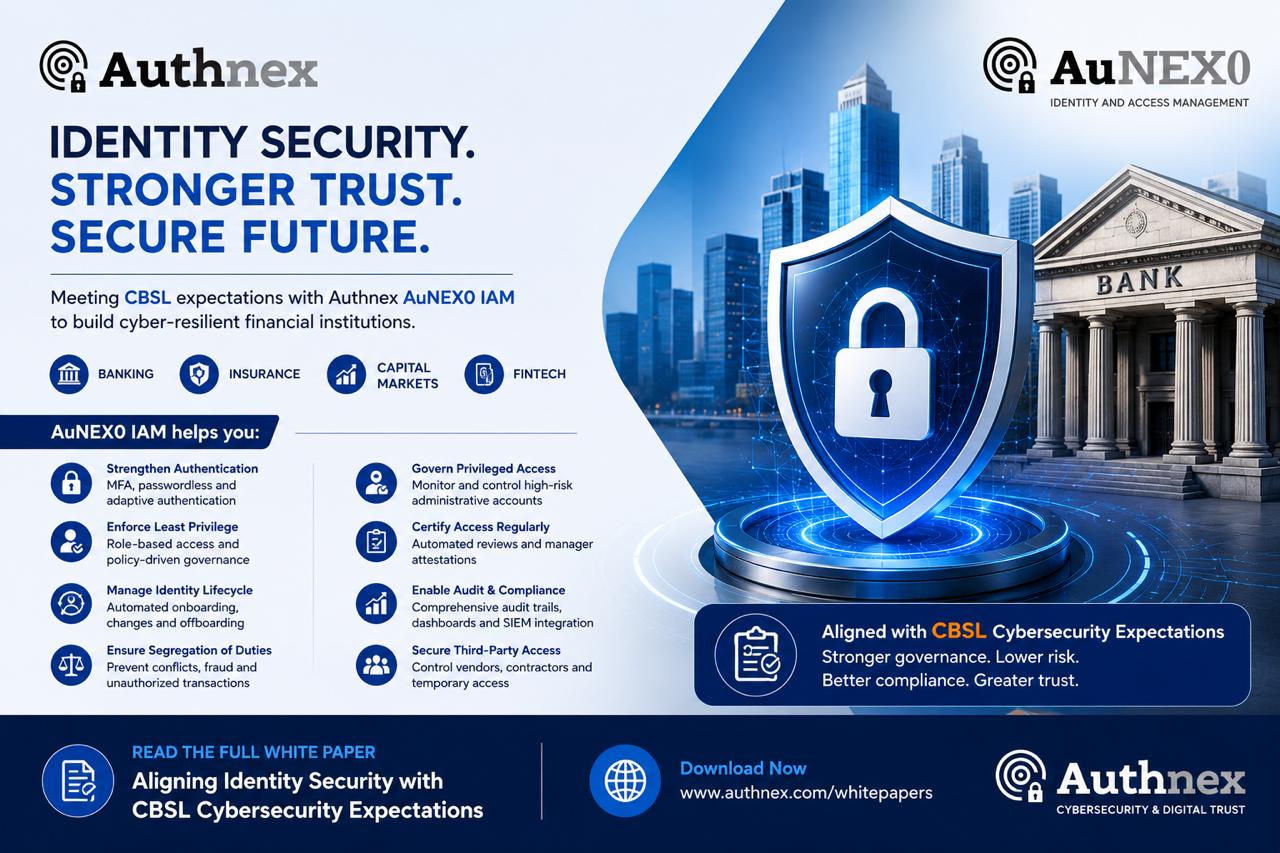

How AuthNEX AuNEX0 Identity and Access Management (IAM) Strengthens Cyber Resilience in Sri Lanka’s Banking and Financial Services Sector
By: Chamara Rupasinghe | Founder / CEO AuthNEX Technologies
- Executive Summary
- The Growing Identity Threat Landscape in Financial Services
- CBSL Cybersecurity Expectations Related to Identity and Access Management
- Introducing AuNEX0 Identity and Access Management
- Mapping AuNEX0 to CBSL IAM Requirements
- Supporting a Zero Trust Security Architecture
- Benefits for Internal Audit, Risk, and Compliance Teams
- Beyond Banking: Applicability Across Financial Services
- Business Value of AuNEX0 IAM
- Conclusion
- About AuthNEX Technologies
Executive Summary
Identity has become the new security perimeter.
As financial institutions accelerate digital transformation, cloud adoption, remote work, API-driven ecosystems, and third-party integrations, identity-related attacks have emerged as one of the most significant cybersecurity risks facing the Banking, Financial Services, Insurance, and Capital Markets (BFSI) sector.
The Central Bank of Sri Lanka (CBSL) has continuously emphasized the need for stronger cybersecurity governance, access controls, authentication mechanisms, privileged access monitoring, and regulatory compliance to safeguard customer information and critical financial infrastructure. While CBSL guidance and industry cybersecurity frameworks establish what organizations must achieve, institutions require practical technology platforms that enable them to implement these controls consistently and effectively.
Authnex AuNEX0 Identity and Access Management (IAM) platform addresses this challenge by providing a comprehensive identity security framework encompassing:
- Identity Governance and Administration (IGA)
- Single Sign-On (SSO)
- Multi-Factor Authentication (MFA)
- Privileged Access Governance
- Access Certification
- Role-Based Access Control (RBAC)
- Identity Lifecycle Management
- Audit and Compliance Reporting
- Third-Party and Vendor Identity Management
- Adaptive, Risk Based Authentication
This paper demonstrates how AuNEX0 aligns with CBSL cybersecurity expectations and assists financial institutions in reducing identity-related risks while strengthening regulatory compliance and operational efficiency.
The Growing Identity Threat Landscape in Financial Services
Globally, more than 80% of successful cyberattacks involve compromised credentials, misuse of privileged accounts, or inadequate access controls.Common threats affecting financial institutions include:
| Identity & Access Threat | Description |
| Credential Theft | Attackers obtain usernames and passwords through phishing, malware, and data breaches. |
| Privilege Escalation | Unauthorized users gain elevated access to sensitive systems and data. |
| Insider Threats | Current or former employees misuse legitimate access privileges. |
| Third-Party Risks | External vendors and service providers become attack vectors into financial networks. |
| Orphaned Accounts | Inactive user accounts remain active after employee transfers or departures. |
| Excessive Access Rights | Users accumulate permissions beyond their business requirements. |
| Weak Authentication Controls | Single-factor authentication remains vulnerable to compromise. |
For regulated institutions, these risks translate into:
- Financial losses
- Regulatory penalties
- Service disruptions
- Reputational damage
- Loss of customer confidence
Identity security therefore becomes a critical component of enterprise risk management.
CBSL Cybersecurity Expectations Related to Identity and Access Management
The Central Bank of Sri Lanka has consistently emphasized cybersecurity governance through various directions, circulars, technology risk management expectations, and cybersecurity frameworks applicable to:
- Licensed Commercial Banks
- Licensed Specialized Banks
- Finance Companies
- Leasing Companies
- Payment Service Providers
- FinTech Operators
Key IAM-related expectations include:
| CBSL IAM Expectation | Description |
| Strong User Authentication | Institutions should implement robust authentication controls to verify user identities before granting access to systems and information assets. |
| Least Privilege Principle | Users must be granted only the minimum level of access necessary to perform their duties. |
| Segregation of Duties (SoD) | Critical business functions should be separated to reduce fraud and operational risks. |
| Privileged Account Management | Administrative accounts require enhanced monitoring and control. |
| Access Reviews and Recertification | Organizations should periodically review user privileges to ensure ongoing appropriateness. |
| User Lifecycle Management | Provisioning, modification, and deprovisioning of access should be governed through formal processes. |
| Monitoring and Auditability | Security-relevant events should be logged, monitored, and retained for investigations and audits. |
| Third-Party Access Governance | External vendors and contractors must be subject to the same access controls as internal users. |
Introducing AuNEX0 Identity and Access Management
AuNEX0 is an enterprise-grade Identity and Access Management platform designed to provide centralized identity governance, authentication, authorization, and compliance capabilities.The platform enables organizations to establish a Zero Trust identity framework where every access request is authenticated, authorized, monitored, and auditable. Core capabilities include:
- Identity Governance and Administration
- Multi-Factor Authentication
- Single Sign-On
- Role-Based Access Control
- Workflow-Driven Access Requests
- Access Certification
- Privileged Access Governance
- Audit Reporting
- Directory Integration
- Cloud and On-Premises Application Integration
- API Security Integration
- Adaptive Risk-Based Authentication
Mapping AuNEX0 to CBSL IAM Requirements
| CBSL IAM Control Area | CBSL Expectation | AuNEX0 Capability | Compliance Benefit |
| Strong Authentication Controls | Financial institutions should strengthen authentication mechanisms to reduce credential compromise risks. | Multi-Factor Authentication (MFA)OTP AuthenticationMobile Authenticator ApplicationsPush AuthenticationFIDO2 Passwordless AuthenticationBiometric Authentication IntegrationRisk-Based Adaptive Authentication | Significantly reduces the risk of credential theft, phishing, and account compromise. |
| Access Governance & Least Privilege | Access rights must be aligned with business requirements. | Role-Based Access Control (RBAC)Policy-Based Access AssignmentAutomated Access ProvisioningBusiness Role ManagementApproval Workflows | Ensures users receive only appropriate access based on job responsibilities. |
| Identity Lifecycle Management | User onboarding, transfers, and exits should be controlled through formal processes. | HR System IntegrationAutomated Joiner-Mover-Leaver ProcessesWorkflow-Based ApprovalsAutomatic DeprovisioningTemporary Access Management | Reduces orphaned accounts and unauthorized access risks. |
| Privileged Access Governance | Administrative accounts require enhanced oversight. | Privileged User IdentificationElevated Access Approval WorkflowsSession Monitoring IntegrationPrivileged Activity AuditingEmergency Access Governance | Strengthens control over high-risk administrative accounts. |
| Segregation of Duties (SoD) | Critical transactions and functions should not be controlled by a single individual. | SoD Policy EngineAccess Conflict DetectionWorkflow EscalationsRisk-Based Approval Controls | Helps prevent fraud, operational errors, and unauthorized transactions. |
| Access Certification & Recertification | Periodic reviews of user access should be performed. | Scheduled Access ReviewsDepartmental CertificationsManager AttestationsCompliance Reporting Dashboards | Maintains continuous compliance and access accuracy. |
| Auditability & Monitoring | Organizations should maintain comprehensive audit trails. | Centralized LoggingAuthentication Audit TrailsAccess Approval HistoryCompliance DashboardsSIEM Integration | Supports internal audit, external audit, regulatory inspections, and forensic investigations. |
| Third-Party Identity Governance | External parties should be governed through controlled access mechanisms. | Vendor Identity ManagementContractor Lifecycle ControlsTemporary Access PoliciesMFA Enforcement | Reduces third-party cyber risks and supply-chain vulnerabilities. |
Supporting a Zero Trust Security Architecture
Modern cybersecurity frameworks increasingly adopt Zero Trust principles.AuNEX0 supports Zero Trust by enforcing:
- Verify Every User
- Verify Every Device
- Continuous Authentication
- Context-Aware Access Decisions
- Least Privilege Enforcement
- Continuous Monitoring
This approach aligns with evolving global cybersecurity practices and strengthens institutional resilience against sophisticated threats.
Benefits for Internal Audit, Risk, and Compliance Teams
AuNEX0 delivers significant governance advantages beyond IT security.
| Stakeholder Group | Key Benefits Delivered by AuNEX0 IAM |
| Internal Audit | Complete audit trails for all identity and access-related activitiesAccess review and certification evidence for audit assessmentsSegregation of Duties (SoD) validation and conflict reportingSupport for regulatory audits and compliance reporting |
| Risk Management | Reduced identity-related cybersecurity and operational risksEnhanced effectiveness of access control frameworksImproved operational resilience through automated governance controlsStronger oversight of third-party and vendor access risks |
| Compliance Functions | Improved regulatory readiness and audit preparednessEvidence-based compliance reporting and documentationAutomated access certification and recertification campaignsContinuous monitoring of access control compliance and policy adherence |
Beyond Banking: Applicability Across Financial Services
While Identity and Access Management is often associated with the banking sector, the same identity-related risks exist across the broader financial services ecosystem. AuNEX0 IAM provides a unified identity security framework that enables Banks, Finance Companies, Insurance Providers, Capital Market Institutions, FinTechs, Payment Service Providers, and Digital Financial Services organizations to strengthen security, improve compliance, and support digital transformation initiatives through centralized identity governance and access control.
| Industry Sector | Key Challenges | How AuNEX0 IAM Helps |
| Insurance | Managing sensitive policyholder information, distributed agent networks, customer self-service portals, and regulatory compliance requirements. | Secure agent and employee accessCustomer portal authenticationThird-party service provider governanceSupport for regulatory and compliance requirements |
| Capital Markets | Protecting trading platforms, privileged users, market-sensitive information, and meeting regulatory oversight requirements. | Strong trader and user authenticationCentralized access governancePrivileged access controlsAudit and regulatory reporting support |
| FinTech & Digital Finance | Rapid growth, cloud adoption, API-driven ecosystems, and large-scale customer onboarding. | Rapid user onboarding and provisioningSecure API and application accessCloud-native identity controlsScalable authentication and access management infrastructure |
Business Value of AuNEX0 IAM
Organizations implementing AuNEX0 typically achieve:
| Strategic Business Benefit | Value Delivered by AuNEX0 IAM |
| Improved Security Posture | Reduces identity-related attack surfaces through strong authentication, access governance, and continuous monitoring. |
| Enhanced Regulatory Compliance | Supports CBSL cybersecurity expectations, regulatory requirements, and industry best practices for identity and access management. |
| Operational Efficiency | Automates user provisioning, access approvals, and identity lifecycle processes, reducing administrative overhead. |
| Reduced Audit Findings | Enables consistent enforcement of access governance controls and provides comprehensive audit evidence. |
| Lower Risk Exposure | Improves governance of privileged accounts, user access rights, and third-party identities, reducing operational and cybersecurity risks. |
| Better User Experience | Delivers seamless access through Single Sign-On (SSO) and adaptive authentication while maintaining strong security controls. |
Strategic Considerations for BFSI Leaders
| Strategic Consideration | Business Impact |
| Identity Security as a Business Risk | Identity security should no longer be viewed solely as an IT responsibility; it is a critical component of enterprise risk management. |
| Board and Executive Oversight | Boards, executive management, risk committees, and audit committees increasingly recognize identity-related threats as a significant organizational risk requiring governance and oversight. |
| Regulatory Expectations | Financial institutions are expected to demonstrate effective identity governance, access controls, auditability, and accountability to regulators and auditors. |
| Digital Transformation Enablement | A modern IAM platform provides the security foundation required for cloud adoption, digital banking, mobile services, API integrations, and third-party ecosystem connectivity. |
| Operational Resilience | Effective identity governance strengthens business continuity, reduces insider risks, and supports cyber resilience objectives. |
| Zero Trust Readiness | Identity-centric security enables organizations to adopt Zero Trust principles by continuously verifying users, devices, and access requests. |
A modern IAM platform enables organizations to:
- Strengthen cybersecurity resilience
- Support regulatory compliance
- Reduce operational risk
- Improve governance
- Accelerate digital transformation initiatives
As the financial sector continues its digital evolution, Identity and Access Management becomes a foundational control supporting trust, resilience, and regulatory confidence.
Conclusion
Cyber threats targeting identities continue to increase in frequency and sophistication across the financial sector. CBSL’s cybersecurity expectations emphasize the need for robust authentication, controlled access, governance, monitoring, and accountability.
Authnex AuNEX0 Identity and Access Management platform provides a comprehensive framework that helps banking, finance, insurance, and capital market institutions implement these requirements effectively.
By combining identity governance, strong authentication, privileged access controls, lifecycle management, and compliance reporting within a single platform, AuNEX0 enables organizations to strengthen cyber resilience while supporting operational efficiency and regulatory readiness.
Identity is no longer simply an IT concern, it is a business-critical security control and a cornerstone of modern digital trust.
About AuthNEX Technologies
Authnex Technologies is a Sri Lankan cybersecurity and digital trust solutions provider specializing in Identity and Access Management (AuNEX0), digital signing services, authentication technologies, and enterprise security platforms that help organizations establish secure, compliant, and resilient digital ecosystems.